
Principle 2. Create learning spaces for all.
Good teaching starts at the beginning of the year – organizing the space of the classroom in ways that can support effective teaching practice and learning for all students. The teacher creates space that encourages children to work together, has places to be alone, and provides materials for all to use in an efficient manner.
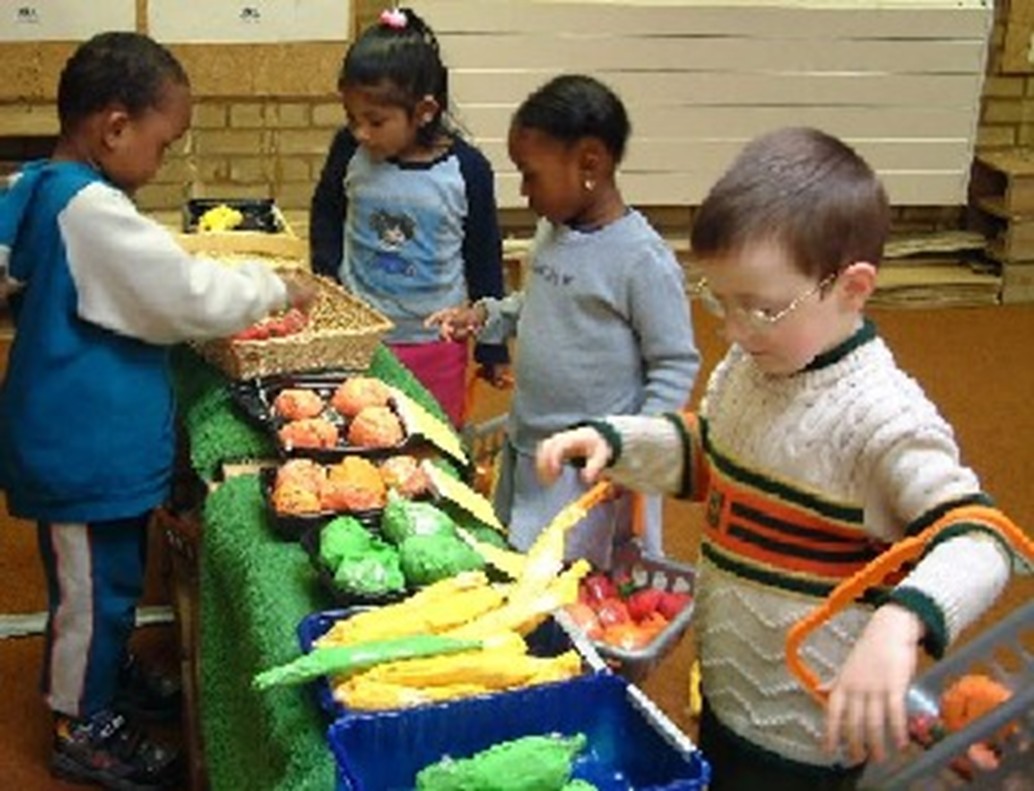
Good teaching starts at the beginning of the year and every day– organizing the space of the classroom in ways that can support learning for all students. Teachers use the range of learning styles, disabilities, and gifts of students as an opportunity to carefully analyze and make changes in the layout of the class and materials to maximize student growth for personal excellence and citizenship. Let’s visit a couple of schools and classrooms.
The figure below provides some ideas for using the principles of universal design to shape environments so that they are accessible and encouraging to all students, limiting the need for individual accommodations. Notice that the chart uses the three environments of school, classroom, and community in interaction with the three key areas around which we have structured this book—(1) academic learning, (2) social–emotional needs, and (3) physical–sensory abilities. This chart offers ideas to get you started as you plan your class at the beginning of the year.
Part of building a learning community is creating an environment both students and teachers enjoy. This is important for secondary as well as elementary students. If we are to build community in our class, we must organize space to encourage student interactions, cooperative work, and collaboration. If we are to teach authentically, our class will begin to look like a workshop.
The walls can be a collage of interesting materials to explore and from which to draw ideas. These will include student work, book covers, artwork, artifacts from places being studied, information on famous people, multiple posters, a calendar, maps, interactive bulletin boards to do in spare time, pictures, and anything else that will pique students’ interest. Teachers involve students in deciding what types of work and artifacts should be displayed.
Many effective elementary teachers put quiet areas, like reading, writing, or listening centers, on one side of the room and louder areas, like science, math, and art, on the other. Windows can be used to create a science area that includes growing plants or birds at a feeder, and we might put the aquarium or art center by the sink. Plants and lamps add to the appeal of these areas and create a comfortable atmosphere. An area does not have to be large to be effective. A poetry area could simply be a bucket full of poetry books located near a poetry bulletin board that the children change weekly.
In a middle or high school class, we can use similar strategies. We may have activity areas for centers that focus on different activities, group work, and small group discussions; a video center with tapes, videotapes, and CD-ROMs; a place for art and design work. Computers may be either in one part of the room or spread around. Plants and animals can be valuable in a secondary class as well.
Toward Effective Design of Classroom and School
|
|
School |
Classroom |
Community |
|
Academic |
< Student work all over the building < Total school staff who see themselves as supporting student learning < Effective library and media center that is accessible to students and offers materials at many different levels < Computers in the media center that have talking software, speech to text, scanners, etc. |
< Books and other resources for different ability levels < Talking computer software < Multiple tools to use to express learning—speech-to-text software, graphics, audiotapes < Sound amplification devices; FM receivers available as needed < Visual magnification devices available; large-print display and software for computers < Sign language offered as a foreign language class |
< Mentors who come into the school and read or do investigations with students < Community organizations that host student learning activities < Accessible playgrounds and museums |
|
Social–emotional |
< Welcoming place—student and staff greeters < Parent and community volunteers < Supportive and caring culture < Cheerful building with work of students highlighted throughout |
< Places to work together, or alone in privacy < Peer buddies < Circles of support < Student participation in organizing and decorating of room < Classrooms filled with student work |
< Local places where businesspeople and community members welcome students < After-school mentors and circles < After-school programs involving community members and parents |
|
Sensory–physical |
< Wheelchair access < Clear signs using both words and pictures < Displays of student work that encourage looking, touching |
< Talking software and input devices < Braille printout from computers < Places for movement in the class < Allowance for drink and food < Clear labels for materials in the class with picture cues < Spaces for wheelchair access |
< Accessible playground equipment < Accessible public buildings and businesses |
Teachers organize the classroom where students have a range of options for working and interacting with other students. These include: individual work, pairs of students; small groups of 3-6 students; sections of the class, and the whole class.
be done simply by addressing the class as a whole as they remain in their typical seats. However, a teacher might prefer to have a space for a section of the class or the whole class. Bringing a large rug to the class to provide a soft place for students to sit.
Small groups of 4-6 students may work at tables. If the class does not have tables desks can be pushed together to form a working area. Students can also simply sit together on the floor.
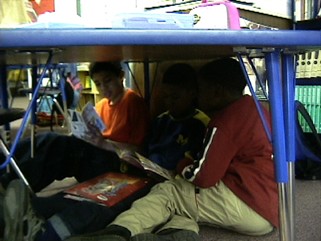
For individual work students may work at a table or their desk. However, it’s also helpful to create unusual spots where distractions are reduced and there is a comfortable feeling: students can go just outside the classroom and sit in a desk put there for that purpose or they can sit on the floor and work. If the student is drawing the floor can be an excellent working space. Within the classroom locating areas behind other furniture can be very helpful where students can have a space where they feel apart from the rest of the class.
We can allow kids choices about whom to sit with. One tenth-grade computer lab teacher says, “You may sit anywhere, as long as you are working!” What is important is not that students are sitting in their seats but that they are learning and having fun. We find that given choices, students will end up in many varied seating arrangements. Having places where kids can sit in chairs is only one option.
The teacher may wish to have a place where all students can come together. This can Other approaches:
- Provide pillows and carpet squares to sit and work on.
- Demarcate standing stations at cabinets, podiums, or counters for when students
need to work but are tired of sitting. - Furnish old easy chairs or rockers to be comfortable on.
- Plan areas that are under, behind, or beside things where students can feel private.
- Allow students to sit on tables and cabinets.
- Let students work in the hallway at an extra desk or table or on the floor.
- Clearly state that students can sit at anyone’s seat as long as they respect the person’s possessions.
|
WHOLE SCHOOLING |
Segregated |
|
< There are no special education, bilingual, or Title I classrooms. Specialists are housed as teams in offices. < Technology and “specials” are integrated into ongoing classroom instruction, and special and general education classroom teachers work together to integrate instruction. |
< The school has special classes for special education, bilingual, and Title I classes that are most often at the end of the hall. < Specialists’ offices are separate from those of the rest of the school staff. |
|
Classroom |
|
|
< Students work in groups at tables or clusters of desks; there is a hum of activity. < Groups of students include diverse ability levels, ethnic and cultural groups, genders. < Students’ work covers the walls, hangs from the ceiling, is displayed outside the room. < Students are seen in many places—at desks and tables, sitting on the floor and on bean bags, out in the halls working in pairs. < Speech therapists, special education teachers, and other support staff come into the class and help with students. However, you can’t tell who they are there to work with. |
< Desks are arranged in rows; some desks are at edge of room. < Students are grouped by ability levels as they engage in activities. < Students of color are most often in the lower-level ability groups. < Teacher-made bulletin boards abound with rules and lists of consequences for infractions. < Students sit at desks. The teacher attempts to ensure that they are quiet, in their seats, and working independently. < Some students leave periodically for special help, causing a good deal of coming and going. < Students with disabilities are not allowed to mix with other students, even at recess or lunch. |
|
Community |
|
|
< Students frequently go on short or longer study trips into the community. < Local community organizations and individuals come into the school. < The school has an active community and parent center where local people organize their work in classrooms and student engagement in the community. < Students in the school are actively involved in studying local community issues. |
< Students stay in the school building all day, except when they go to the playground. There is little connection with the local community. < When students with disabilities finish school, they go to sheltered workshops and group homes. |
In a Whole School, specialists have designated work spaces in the general education classroom. Some classrooms may have two desks, one for the general education teacher and the other for a specialist or support teacher. In other classrooms specialists and the teacher might share one desk, since they are seldom in that area for any length of time.
Often these specialists will also be housed together in an office, freeing up some space where teachers can counsel individual students and parents or work with small of groups of students in activities.
Housing a small group of specialists together also has potential to increase day-by-day communication regarding issues, needs, and strategies being implemented with specific students.
A commons area may be located in a central area of the building with park benches, water fountains, and other amenities to encourage conversation and interaction. A commons gives students a place to gather before and after school and at lunch, and serves as a gathering point for groups. Schools often intentionally locate their commons next to the school administration office to convey a sense of openness, and administrators often interact informally with students and parents.
The figure on the right shows using Whole Schooling design rather than having some students separated and segregated from other students.
RESOURCE LINKS: Create learning spaces for all
Create learning spaces for all. Search in google and see what AI tells you.
What Maker Education and the Arts Teach Us About Creating Inclusive Learning Spaces.
Tips for Creating Wow-Worthy Learning Spaces.
7 Steps to Creating a Successful Modern Learning Space.
Creating Next-Generation Learning Spaces.
Redefining Learning Spaces: A Journey Towards Universal Design.
5 Ways to Create an Inviting, Engaging Multipurpose Learning Space.