
WHOLE SCHOOLING RENEWAL
Whole Schooling renewal relies heavily on what is most powerful in helping improve schools -- the development of a school learning community in which staff dialogue about their vision, concerns, and strategies for improving student learning and discuss needed school-wide programs, structures and supports. The aim is to support dialogue and engagement that empowers teachers, parents, and students. Below, we discuss strategies and approaches that may be useful in focussing engagement of the school learning community.
Key Questions
Central to planning for school renewal using the 9 Principles of Whole Schooling is the agreement of the staff that the Principles provide a valuable and needed set of goals towards which the school should move. If this is true, then all involved with the school - teachers and other staff, parents, and students - may consider the degree to which the school as a whole, as well as individual classrooms, are based on the 9 Principles of Whole Schooling. Teams may then develop strategies for improvement. Following are examples of key questions that will be addressed to develop action plans.
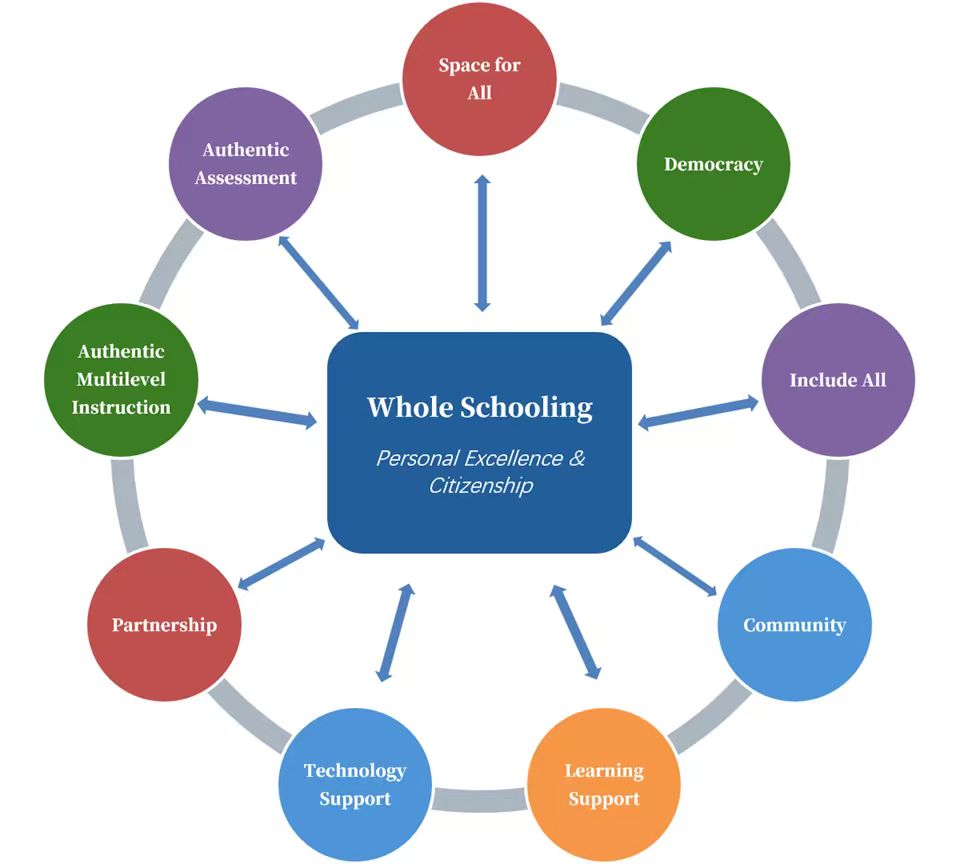
- Empower for democracy. To what degree are multiple constituencies involved in making significant school decisions? How are students involved? Do students have multiple opportunities for daily decision-making, choices in their studies, opportunities to use power, involvement in resolution of conflicts?
- Space for all. How can we use the physical resources of the school and classroom to best respond to the learning style and needs of students? How can we use space to encourage authentic learning, interaction in a learning community, providing time and place to be alone as well as working in small groups?
- Include all. Who is in the school? Who is not? Where are students who would typically come to this school? How might the school connect its students to other students with diverse characteristics (important for schools without racial or ethnic diversity)?
- Build community. Does a sense of community pervade the school at all levels – staff, parents, children? What specific strategies are used? How might the school strengthen community through concrete, specific strategies? Is there a commitment to children with social-emotional challenges and problems? Is positive behavioral support integrated into schooling and classroom practice? How might the school strengthen community and ways to proactively meet the social and emotional needs of children?
- Support learning. Are support staff being used to support students in the general education class? Do they work as a support team for the entire school addressing academic, technology, social-emotional, medical, and other needs of students? Do they work with teachers to improve authentic, multi-level instruction, building community, and using positive behavioral supports in the classroom?
- Partner with families and the community. To what degree do parents feel a partnership with parents, particularly parents of students with high challenges – those with disabilities and highly able students? To what degree are the resources, gifts, and talents of parents and the local community used to strengthen learning? How might the school break down the barriers between school staff, parents, and community?
- Teach all using authentic multi-level instruction. To what degree are instructional strategies used in the school to help students with very differing ability levels learn well together? Are there teachers who are using exemplary strategies? How might they assist other teachers in the school? What assistance does the school staff need in learning how to do multi-level instruction?
- Use technology to facilitate student learning. How well is technology being used in the school to support student learning? Is technology being used to access resources which allow for multilevel learning? Is technology being used to effectively communicate with parents? What are areas for improvement in use of technology?
- Assess to support learning. How can teachers and other educators assess student learning in a meaningful way? How can we focus on a holistic view of the student, looking at authentic academic achievement, development of social and emotional capacity, identifying key student strengths? How can we use assessment to understand better how a student learns and how we might best teach this student?
Tools for Self-assessment and action planning
Below are a couple of tools that may be useful in conducting assessment of strengths and needs related to Whole Schooling in your school building.
- Whole Schooling: Strengths and Needs of Your Class and School (WSSchlNeedsOpen) This tool provides an open ended place for individual teachers and teams of teachers to list and dialogue about both strengths and needs related to each of the 9 principles of Whole Schooling.
- Quality Teaching for ALL: Self-Assessment Rating Scale (Quality Tch for ALL 2025.doc). This tool is organized by the Principles of Whole Schooling. A variety of items intended to reflect exemplary practice are listed for each principle and the respondent rates the school or individual classroom using a 5 point Likert scale.
Strengths and Needs Regarding Whole Schooling in Your School
You may find it useful to provide an overview of Whole Schooling for staff and then to divide the school staff into 8 groups, one for each principle. Each group is asked to use the open-ended questionnaire. Each individual brainstorms on the form and then the group ha a discussion and records it’s answers on chart paper. All groups then report back to one the whole team sharing their results and asking for additional input from the rest of the staff. This information can be typed and recorded and can become a key starting point for an action plan for school improvement.
Developing a Vision and Action Plan for the School: MAP & PATH
You may find it helpful to use the Making Actions Plans (MAPS). This process is a particularly powerful tool for use with a staff is to engage the staff in developing a vision for the type of school they would like to be and an action plan to move in that direction. Yuo need two people to lead: (1) a facilitator of dialogue; and (2) a graphic recorder – an individual who will capture the essence of discussion in words and graphic images. As a group you will walk through the following questions:
1) What is a MAP? (as an introduction);
2) What is our story or history as a school?
3) What is the dream for our future as a school?
4) What is the nightmare? (fears/worst-case scenario)
5) Who are we (key characteristics; how we see ourselves)?
6) What are our gifts, strengths, and talents? (these can in relation to the 9 principles of Whole Schooling
7) What are our needs for improvement?
8) What is the plan of action? (next steps)
School-wide Adoption of Whole Schooling
If you are interested in using Whole Schooling you will want, as a staff, to agree on adopting the 9 principles of Whole Schooling to guide your plans for school improvement. At best, staff develop a consensus that the Principles of Whole Schooling reflect the type of school they would like to become, consensus being defined, not as total agreement, but a willingness of all to work together rather than derailing efforts at change.
Involving students and parents
Students and parents can be involved in helping to make the school and classroom a better and more effective place. Teachers may ask students and parents to complete one of the school-wide self-assessment tools and have a group discussion in a special evening meeting. This could be a particularly powerful way for a grade level team in an elementary school or interdisciplinary team or 'house' in a middle or high school to obtain powerful information from students. .
Professional Development
The 9 Principles of Whole Schooling, in association with strengths and needs assessments described above, may also be used as a template for developing local professional development opportunities and identifying conferences and other external professional development events available in a local area.
Resources
International Journal of Whole Schooling
The International Journal of Whole Schooling (IJWS, ISSN 1710-2146) is an online Journal that has functioned for more than 20 years that invites articles related to Whole Schooling. Many excellent articles have been published from authors all over the world.
Whole Schooling Book and Learning Activities
Dr. Michael Peterson and his teacher daughter Mishael Hittie have written a book related to the implementation of whole schooling entitled Whole Schooling: The Journey Towards Schools Where Diverse Students Learn Together Well. They have provided numerous learning activities that involves teams and small groups working together for each of the 13 chapters of the book. Click on the link below to access these activities.
- Celebrate Difference: Promoting an Inclusive and Caring Society through Education
- Introduction to Whole Schooling: Educating All Children Together Well
- Diverse Students In The Classroom: How Students Are Different And The Same
- Planning Individualized Differentiation: Interventions For Students with Special Needs
- Provide Support and Collaborate: Get Help and Build a School Community
- Partner with Families and the Community: Build Relationships For Learning
- Develop an Inclusive School and Classroom: Use Space and Physical Resources to Support All Students
- Make Environmental Accommodations and Use Assistive Technology: Tools That Extend Human Capacity and Promote Learning
- Build a Community for Learning: Promote Mutual Care, Support, and Celebration
- Meet Needs of Students with Challenging Behaviors: Positive Strategies for Difficult Situations
- Inclusive Academic Instruction, Part I: Plan Inclusive Lessons and Units
- Inclusive Academic Instruction, Part II: Multilevel and Differentiated Learning Activities
- Inclusive Academic Instruction, Part III: Applications in Subjects