
Principle 6. Partner with families and the community.
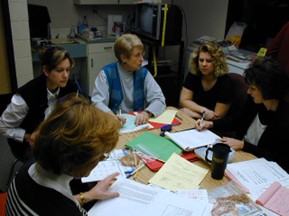
Educators cannot and should not seek to build such a school alone. In a Whole School, educators build genuine collaboration within the school and with families and the community; engage the school in strengthening the community; and provide guidance to engage students, parents, teachers, and others in decision-making and direction of learning & school activities.
 PARTNERSHIP FOR LEARNING:
Linking local resources of school, families, and community to foster engagement and deepen understanding.
In too many schools serving low income children, substantial tension and poor relationships too often exist between parents and the school. Educators blame parents for their lack of interest in their children. Parents blame teachers for not helping their children learn. Whole Schooling recognizes the need to develop multiple strategies to reach out to parents, bringing them into the life of the school and the classroom in meaningful ways, listening to their input regarding their children, developing collaborative instructional and support strategies. All this begins, of course, with simply welcoming all children into the class. Further partnerships are needed in an effective school that link with community resources, on the one hand, and use the resources and learning activities of the school, on the other hand, to strengthen the local community. Parents of children with special needs have typically gone through much with their children. In traditional schools, these parents receive much negative feedback from the school. Their children are rejected and ‘sent away’ to special education classes or separate schools.
In a whole school, however, we turn this around by the following actions:
- Parents are immediately invited to have their children in inclusive classes.
- Meeting with and listening carefully to what parents have to tell us about their children. We seek to understand the child’s gifts, strengths, and needs, strategies that work, and interests of the child from the parent.
- Welcoming their child into our classes. We communicate that we want their child in our school and obtain their input for his or her educational plan.
- Invite the parent into the school and class. Make them welcome and a part of the school family and community.
- Insure that they are involved in the full life of the school.
In addition to partnering with parents we also seek ways of linking classroom learning to the community. We aim to connect students with community resources as part of their learning. Examples include:
- community-based learning projects
- adult mentors coming to the classroom to share their life experiences or read to students
- community members are connected with students to mentor them
- involvement of community individuals and organizations in instructional and after school programs (e.g. artists, musicians, violence prevention, and mental health)
- teachers look for opportunities in the community where students may be involved in community improvement projects as part of their learning.
To do this well, of course, means that teachers should engage themselves in community activities getting to know local resources. Teachers encourage students to seek out family and community resources in the course of their school learning projects.
Michael Peterson, 2025
RESOURCE LINKS: Principle 6. Partner with families and the community.
Fostering the Home-to-School Partnership.
Connect and Collaborate With Families.
5 Culturally Responsive Family Engagement Strategies.
A Dual Capacity-Building Framework for Family–School Partnerships.
Family and Community Engagement in Schools: A Deep Dive.
Educating our Children Together: A Sourcebook for Effective Family-School-Community Partnerships.
Three Powerful Examples of Family Engagement in Schools to Inspire You.