
Purpose of Schools
Create better schools?
In recent years, many have called for improvement in public schools, decrying the poor achievement of many students, particularly students who have low incomes, disabilities, or other factors that place them at risk. Do schools need improvement? Virtually all analysts agree that they do. Most agree that students who are poor, have disabilities, are at risk, or highly able and gifted, often don’t receive appropriate education.
Different policy initiatives have taken somewhat different approaches to improving education. In recent years in the United States and other countries these include: (1) setting standards for each grade level -- in practice, lists of information and skills, (2) establishing standardized tests, (3) and providing repercussions when students do not meet expectations. These begin with letting parents know that their school is a ‘failing’ school to reconstitution of the school staff.
Legislation related to students with disabilities has taken a different approach. In 1975, the Education for All Handicapped Children developed a revolutionary policy – that all students should be educated by public schools no matter the severity of their disability in the “least restrictive environment”, the regular class supplemental services being the preferred placement. The legislation, now known as the Individuals with Disabilities Education Act (IDEA) centers on the development of Individualized Educational Programs (IEP) for students with disabilities based on their needs, ‘least restrictive environment’, assurance that parents have a right to due process when disagreements occur, and that all students have the right to a 'free and appropriate public education'. Many other countries have similar policies.
For all the fanfare about identifying outcomes of learning (standards) and the accountability of schools to produce such outcomes, there has been relatively little discussion in policy about how effective schooling and teaching practices actually look. Clearly, if we want to create schools in which all children succeed to their highest abilities, then we must understand what practices support such outcomes and what practices are detrimental. It is the goal of Whole Schooling to articulate such effective practices.
The purpose of schools
Why do we have school in the first place? What is the purpose of schooling and teaching?
If we don’t know what the mission and goals of school are, it’s not possible to even know if we get there. We also don’t know if the target was missed. Interestingly, with all the focus in recent years on accountability of schools, you don’t see that much public discussion about the fundamental purpose of schools.
Two primary opposing views exist regarding the purpose of schools. Some believe that the primary purpose of schools should be to create workers who have skills and personal styles to fill and perform available jobs. Others believe this outcome is too narrow. For them schools should seek to develop active citizens, helping children develop their own capacity for personal achievement and contributing to society as an active citizen for democracy.
These two goals, producing workers and creating citizens, require two very different approaches. If, on the one hand, the key goal is to educate students as workers, where education essentially functions as a section of the personnel department for business and industry, schools are expected to perform two essential tasks: (1) create a pool of workers with at least minimum competence and attitudes from which businesses can select employees; and (2) provide a way of sorting workers in rank order of ability, eliminating those from the pool who do not have the perceived capacity to function as employees. The goal for businesses, of course, is to have a large pool of potentially qualified candidates with requisite skills that exceeds the availability of jobs. The resulting competition for jobs allows businesses to keep wages lower, thus decreasing costs and increasing profits.
Following are some key strategies that may lead to schools accomplishing these personnel office functions in the societal service of business. They most often include:
- Identify basic skills that all students should achieve, skills needed in most jobs in business and industry
- Use tests to rank students or, at minimum, identify students as competent or incompetent on basic skills
- Increase the number of students meeting competence in basic skills.
- Assure that the curriculum focuses narrowly on the basic skills rather than curriculum options that address individual interests and needs
- Facilitate conditions where students with challenges drop out.
Differing Approaches to Learning Goals and Evaluation of Schools
|
Same Teaching for All Accept different outcomes |
Same Standard for All Expect same outcomes for all |
Personal Excellence Expect different outcomes based on individualized excellence |
|
Develop curriculum strands across subjects guiding curriculum content. |
Establish expectations of academic facts and knowledge for every age and grade level organized around traditional academic subjects – reading, writing, math, social studies, science. |
Develop outcome goals for students that reflect the overall purpose of schools – citizenship, academic skills, social-emotional abilities, character. Develop strands for curriculum content linking subjects. |
|
Provide the same instruction for all students. |
Expect students to achieve these standards irregardless of ability, background, or prior knowledge. |
Expect students to make ongoing growth and progress, starting with present understanding and deepening and widening. |
|
Assessment is based on the ability of the school to provide equal educational experiences to all students. |
All students take a standardized test as a measure of identified skills and content knowledge. |
All students will be assessed to determine individual progress. School-wide reporting systems are developed to reflect this. |
If, on the other hand, schools seek to help students achieve personal excellence and become effective citizens, their learning activities are organized quite differently. In such schools, the curriculum would necessarily offer many rich opportunities rather than focusing only on narrow basic skills. Students are nurtured to become adults who have skills, attitudes, and knowledge to be productive community members, leaders, parents, as well as workers. Here’s a short list that schools and teachers would be about in such schools:
- Help students identify their interests and abilities
- Support students in setting personal learning goals
- Facilitate student involvement and learning in decision-making regarding their own learning and the use of power and responsibility in the classroom and school
- Create a culture of care and community where students learn to support one another and take responsibility for the well being of each other and the total community
- Facilitate students learning together in a diverse groups where they learn how to value contributions of others and manage productive group work
- Teach students who are functioning at many differing levels of ability together in heterogeneous mixes
- Assess student skills and learning styles to facilitate learning and promote personal excellence
The 9 Principles of Whole Schooling
Contrasting Principles and Practices
|
Teaching to Leave Many Children Behind Education for Basic Skills and Work |
Good Teaching 4 All Education for Personal Excellence and Citizenship |
|
Learning Climate in the Classroom |
|
|
1. Control Organize the class to maintain control and minimize student interactions. |
1. Space for all Organize the classroom to respond to student learning styles and special needs (Chapter 2). |
|
2. Autocracy Establish rules and management systems to ensure student compliance using rewards and punishments. |
2. Democracy Involve children in decision-making, choices, learning responsibility, and having contributions appreciated (Chapter 3). |
|
3. Segregation Separate students who are significantly above or below grade level. |
3. Include all Include all students in the general education class (Chapter 3 & 4). |
|
4. Isolation Ensure that students work on their own maintaining quiet and control. |
4. Community Help students become a caring community learning respect and valued social skills (Chapter 3 & 4). |
|
Support for Learning |
|
|
5. Pull-out Send students to special education teachers and other specialists outside the classroom. |
5. Support Use specialists to provide support and services in the general education classrooms (Chapter 5). |
|
6. Autonomy Maintain a professional distance in dealing with parents and the local community. |
6. Partnership Develop positive relationships and respectful partnerships with parents and community members (Chapter 9). |
|
Approaches to Instruction |
|
|
7. Grade level Teach to the middle using one-size-fits-all instruction. 8. Pen and paper only. All classwork uses pen and paper only. Technology is limited or absent. |
7. Multilevel Provide differentiated, authentic multilevel instruction (Chapter 6 & 7). 8. Technology supports learning. Use of technology to enhance student learning; use assistive technology if needed (Chapter 8). |
|
9. Standardized test Focus instruction for preparation of the state standardized test. |
9. Authentic assessment Assess students looking at the whole child to promote learning and understanding (Chapter 9). |
|
Outcome Goals |
|
|
Prepare workers Grade level expectations Basic skills Pass state standardized test |
Personal excellence Prepare citizens Use skills in problem solving and creative expression Develop social skills and supportive relationships |
You might ask, “Can we not do both - educate for being a worker and for being a citizen?” From one perspective, the answer is “Yes!” This is true because in working towards personal excellence and citizenship, children and youth also learn how to be effective workers and producers. However, it’s also true that you cannot organize a school and classroom around the strategies for each approach at the same time. You can’t, for example, focus most of your curriculum around basic skills in three subjects and give students opportunities for personal excellence and learning skills of citizenship. The good news is that there is substantial evidence that test scores in schools aiming for personal excellence and citizenship are equal to or higher than schools that focus on narrow curriculum only.
The fact is that most parents and educators do not want education for work as the prime outcome of schooling. They want much more. We often conduct workshops with educators and parents in which we ask them to describe what has made the best year and the worst year for children. Always, teachers and parents state that what made the difference lay more in how the student was treated and had opportunities to pursue learning in areas of high interest rather than how well they did on standardized tests. In other words, , the emotional and social well-being of the child and opportunities to explore areas of great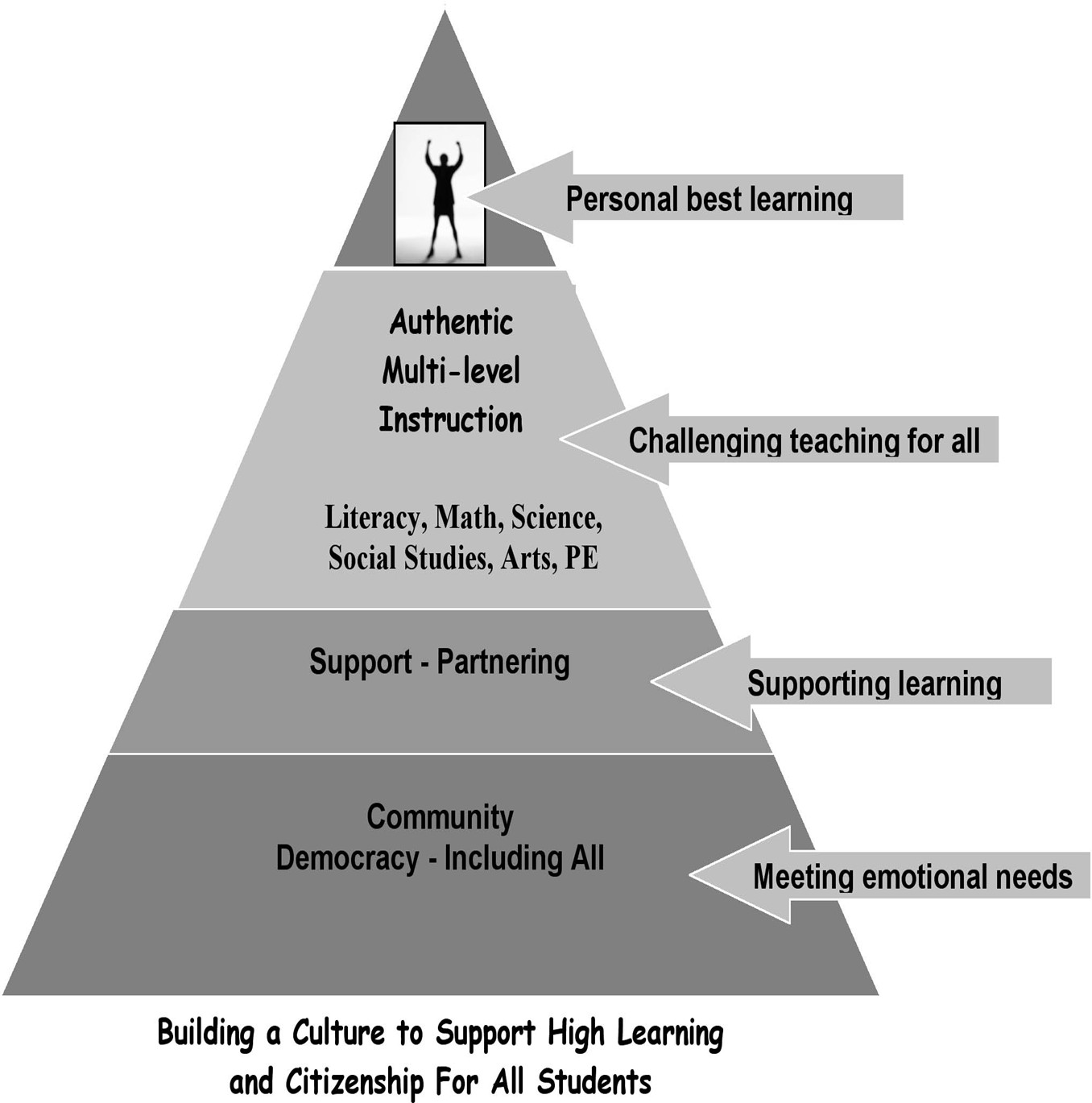 interest is paramount. Helping children develop in these arenas is a key expectation and goal for most people. Following, for example, are some examples of mission statements of public schools:
- Neshaminy is dedicated to empowering students to become accountable, creative, self-aware, and productive citizens who utilize the knowledge, the skills, the social consciousness and the desire for continuous learning (Neshaminy School District, Pennsylvania).
- Elk Grove Unified School District will provide a learning community that challenges ALL students to realize their greatest potential. Outcomes for students; achievement of core academic skills; confident, effective thinkers and problem solvers, ethical participants in society (Elk Grove Unified School District, Elk Grove, California).
- The Board of Directors believes that students should complete school in full possession of skills, knowledge, and insights necessary for responsible, productive participation in society (Searcy Public School, Searcy, Arkansas)
- The Boerne Independent School District exists to prepare its students for responsible citizenship, sound character, lifelong learning, and productive employment through programs and activities which challenge and develop language literacy, mathematical proficiency, scientific competence, and social maturity (Boerne Independent School District, Boerne, Texas).
These are quite serious statements regarding the commitment to what we call personal excellence and citizenship. However, these statements are not unusual. Clearly the missions statements of most school districts is to help students achieve their personal best as they become successful community members. Whole Schooling describes an approach to schooling, teaching and learning aimed precisely at the mission statements of most school districts.
Creating a culture for personal best learning, achievement, and citizenship. How can schools be designed to help create high levels of learning among students that increase individual opportunity? How can schools help children become citizens for democracy, providing social, business, and community leadership to develop innovations and solve important problems. We must pay very close attention to what helps, and what hurts in reaching these important ends.
After several years of studying instructional practices in excellent classrooms and schools we developed Nine Principles that represent a comprehensive synthesis of practices designed to help children learn at high levels, function as leaders on the job and in the community, create a sense of care and community, and value and support truly diverse individuals in working and learning together. We decided to call this approach Whole Schooling.
The 9 Principles of Whole Schooling create a culture and set of practices in schools and classrooms that promote learning and growth for personal best achievement and citizenship. We know that for learning to occur, a foundation must be laid upon which cognitive development can be built. Such a foundation centers in having a place where the child feels safe, accepted, has a sense of belonging, and feels cared for. Including heterogeneous students in classes together is a critical component as is the practice of democracy, systematic sharing of power within the school and classroom. Support to teachers and students and partnering with parents and the community helps fill out the picture of social, emotional, physical and cognitive support needed for high levels of achievement. While the language of school focuses primarily on instruction and the academic subjects of school – reading, writing, math, science and more, without attention to these foundation building blocks, learning will falter.